
HSS is sold under a myriad of trade names in rods, bars, flats and various tool shapes. For this reason, it is an all-too-often occurrence to come across a piece of branded HSS and have no idea what type or grade of HSS it is or perhaps even be unsure if it is or is not HSS.
The following information was compiled to give a rough guide to the composition and principal uses of the many tool steels (HSS and carbon) as well as introduce some of the useful non-ferrous cutting tool alloys.
Type “T” Tungsten-Rich HSS
- T1 (18-4-1) typical analysis (%): C 0.7; W 18; Cr 4.0; V 1.0 – this is the original 18-4-1 high speed steel introduced around 1904. Still held up as a standard general-purpose tool steel. It has a balanced combination of shock resistance and abrasion resistance. It is the easiest HSS to machine. Has high red hardness. Principal application is for cutting tools. However, it has been generally superseded by M2.
- T2 typical analysis (%): C 0.8; W 18.0; Cr 4.0; V 2.0; Mo 0.8 – with higher carbon and vanadium content than T1 and a small molybdenum addition this steel provides a harder and more durable tool edge. Often more economical than cobalt steels it hardens without a soft skin. Not as tough as T1. Suitable for fine edge tools such as hobs and threading dies, form tools, twist drills, reamers, broaches and milling cutters.
- T3 typical analysis (%): C 1.0; W 18.0; Cr 4.0; V 3.0; Mo 0.7 – the triple vanadium and high carbon content of this steel provide the highest wear resistance of any tool steel. It is suitable for cutting hard wrought metals or castings, material that work hardens and soft gummy materials where wear resistance is a major factor.
- T4 typical analysis (%): C 0.75; W 18.0; Cr 4.0; V 1.0; Co 5.0; Mo 0.8 – the addition of 5% cobalt to T1 increases cutting ability at high temperatures, making this steel suitable for hogging cuts where high heats develop. Should be used where tools are well supported, not subject to shock and ground all over after hardening. Generally used for cutting tools, broaches and cold extrusion punches.
- T5 typical analysis (%): C 0.8; W 18.5; Cr 4.0; V 1.75; Co 8.0; Mo 0.8 – the ultimate in HSS for heavy duty cutting possessing a combination of red hardness and toughness that gives outstanding performance. Recommended for heavy duty lathe, planer and boring tools. Especially adapted for cutting hard, gritty material such as cast iron or steel, also heat-treated alloy steels. Best used in tools that are well-supported and not subject to excessive shock or chattering. Cutting speeds can be about 25% faster than T1 with higher tool life.
- T6 typical analysis (%): C 0.8; W 20.0; Cr 4.0; V 2.0; Co 12.0; Mo 0.8 – a high cobalt steel having the highest red hardness of any tool steel. Wear resistance is better than the lower cobalt steels. Suitable for heavy-duty lathe and planer tools.
- T7 typical analysis (%): C 0.75; W 14.0; Cr 4.0; V 2.0 – lowered tungsten content gives increased toughness with less wear resistance. Suitable for intermittent cutting and for sand castings, hard alloys or gritty materials.
- T8 typical analysis (%): C 0.8; W 14.0; Cr 4.0; V 2.0; Co 5.0; Mo 0.8 – wear resistance exceeded only by T3 combined with good red hardness make this steel suitable for severe cutting operations, especially stainless steels. It has also given good results on hard die blocks, manganese steel castings and chilled cast iron.
- T9 typical analysis (%): C 1.25; W 18.25; Cr 4.0; V 4.0; Mo 0.75 – a high vanadium steel for extremely abrasive conditions. Runs best at high speeds with light cuts.
- T12 typical analysis (%): C 1.0; W 14.0; Cr 4.0; V 3.0; Mo 0.75 – a tough high speed steel designed for high resistance to impact. Suitable for variable cutting, such as turning through scale and broaching.
TYPE “T” Cobalt-Rich HSS
- T15 typical analysis (%): C 1.5; W 13.0; Cr 4.25; V 5.0; Co 5.0 - a tungsten / cobalt super high speed steel containing high vanadium for excellent abrasion resistance and cobalt for good red hardness. Ideal for cutting difficult to machine materials where high frictional heat is present. Typical applications include broaches, milling cutters, spade drills, taps, end mills, shaper cutters.
- T15 Powder Metallurgy (PM) primary use is in applications requiring the machining of high-hardness heat-treated materials such as high temperature alloys. The high carbon, vanadium, and cobalt content (same as regular T15) give good wear resistance, hot hardness and hardness. The powder metallurgy process has improved quality from the standpoint of structural uniformity, response to heat treatment and grindability. Typical applications include broaches, chasers, form tools, heavy duty cutting tools, high production blades, milling cutters, reamers, and taps.
TYPE “M” Molybdenum-Rich HSS
- M1 typical analysis (%): C 0.8; W 1.5; Cr 4.0; V 1.0; Mo 8.25 – the high-molybdenum, low-tungsten HSS which is typically used is for cutting tools of all kinds. It has good cutting ability except for heavy-duty continuous cutting operations where the ultimate in red hardness is required. Due to its high molybdenum content M1 is susceptible to decarburisation at high temperatures, consequently in heat treating and heating for forging and annealing care must be used to prevent decarburisation. Both toughness and wear resistance are slightly better than T1.
- M2 typical analysis (%): C 0.8; W 6.0; Cr 4.0; V 2.0; Mo 5.0 - a tungsten molybdenum, general purpose grade which offers balanced shock-resistance and high toughness combined with good cutting powers. Suited for general machining of carbon, alloy and tool steel types. Offers good heat and abrasion characteristics. Standard machining operations can be carried out with M2 high speed steel tool bits. Bits are supplied hardened to approximately 62 to 66HRC.
M2 is the "standard" and most widely used industrial HSS. It has small and evenly distributed carbides giving high wear resistance, though its decarburization sensitivity is a little bit high. After heat treatment, its hardness is the same as T1, but its bending strength can reach 4700 MPa, and its toughness and thermo-plasticity are higher than T1 by 50%. It is usually used to manufacture a variety of tools, such as drill bits, taps and reamers.
M2 is by far the most popular high speed steel replacing T1 in most applications because of its superior properties and relative economy. It has a wider heat-treating range than most of the molybdenum high speed steels, coupled with a resistance to the decarburization characteristic of tungsten types. M2 offers an excellent combination of red hardness, toughness, and wear resistance. Typical applications include gear cutters, broaches, boring tools, chasers, drills, end mills, form tools, hobs, lathe and planer tools, punches, taps, reamers, and saws.
- M3 typical analysis (%): C 1.0; W 6.0; Cr 4.0; V 2.75; Mo 5.0 and M3 (Class 1) typical analysis (%): C 1.05; W 6.25; Cr 4.0; V 2.5; Mo 5.7 and M3 (Class 2) typical analysis (%): C 1.2; W 5.6; Cr 4.0; V 3.25; Mo 5.5 – contains carbon and vanadium levels that are intermediate between those of M2 and M4. This gives the steel a fine balance of wear resistance and grindability and provides superior resistance to abrasion and edge breakdown. This makes M3 high speed steel a superb tool material for form tools and roll turning. Increased tool life will also be experienced in the machining of heat-treated sections, castings and similar hard materials.
M3 was developed after extensive studies of the effect of increased carbon and vanadium contents on the intermediate molybdenum-tungsten high speed steels. The analysis was tried and proven on practically all high speed steel applications. M3 offers the unusual combination of extremely high edge strength at high hardness levels. With few exceptions, best life is accomplished with a minimum hardness of 65.5 Rockwell C. M3 is more readily machined and offers less grinding resistance than higher vanadium types.
Typical applications include drills, taps, end mills, reamers, counterbores, broaches, hobs, form tools, lathe and planer tools, checking tools, milling cutters, slitting saws, punches, drawing dies, and wood working knives.
- M4 typical analysis (%): C 1.3; W 5.5; Cr 4.0; V 4.0; Mo 4.75- a high-vanadium special purpose high speed steel exhibiting better wear resistance and toughness than M2 and M3 in cold work punches, die inserts and cutting applications involving high speed and light cuts. Used for cutting tools of all types for machining operations.
M4 Powder Metallurgy (PM) is a special purpose grade which utilizes its higher carbon and vanadium contents to develop excellent abrasion resistance. Produced conventionally, M4 is difficult to machine in the annealed condition and grind in the hardened condition. M4 PM is produced by the powder metallurgy process and allows the addition of 0.06 to 0.08 sulphur which provides a uniform dispersion of small sulphides throughout the structure and enhances machinability. Coupled with finer carbides and structural uniformity, better grindability is also achieved.
These factors, along with increased toughness, are ideally suited for heavy-duty cold-work applications.
Typical applications include blades, broaches, chasers, die inserts, form tools, lathe and planer tools, milling cutters, punches, reamers, slitter knives, spade drills, and taps.
- M6 typical analysis (%): C 0.8; W 4.2; Cr 4.0; V 1.5; Co 12.0; Mo 5.0 – has high red hardness and properties similar to T6. Suitable for cutting hard materials and heat-treated forgings. Operates at higher speeds and feeds than regular high speed steels. Suitable for cutting hard materials and heat-treated castings. Operates at higher speeds and feeds than regular high speed steels.
- M7 typical analysis (%): C 1.0; W 1.75; Cr 3.75; V 2.0; Mo 8.75 - widely used for cutting tools in machining operations. Exhibits good abrasion resistance because of its carbon and vanadium contents. It is an excellent choice for premium tools which require an outstanding balance of red hardness, edge toughness, and wear resistance. It is especially suited for machining semi-hard, heat-treated steel at about 300-350 Brinell hardness.
- M8 typical analysis (%): C 0.8; W 5.0; Cr 4.0; V 1.5; Mo 5.0; Nb 1.25 – a niobium (formerly known as columbium) bearing high speed steel with unusually high wear resistance. For general-purpose cutting. Resists decarburisation in hardening.
- M10 typical analysis (%): C 0.85; Cr 4.0; V 2.0; Mo 8.0 – one of the high-molybdenum types of HSS it contains chrome and vanadium but is tungsten-free. A general purpose HSS employed in tooling applications requiring excellent wear and cutting capabilities including punches, taps, drills, broaches, lathe tools, shaper tools, planer tools, etc. May also be used for boring tools, countersinks and reamers. Due to its high molybdenum content M10 is susceptible to decarburisation at high temperatures, consequently in heat treating and heating for forging and annealing care must be used to prevent decarburisation.
- M15 typical analysis (%): C 1.5; W 6.5; Cr 4.0; V 5.0; Co 5.0; Mo 3.5 –
- M20 typical analysis (%): C 0.6; W 4.0; Cr 5.0; V 1.25; Co 2.5; Mo 8.0; Boron 0.25 – an economical HSS suitable for taps, threading dies, form tools and broaches.
Type “M” Molybdenum-Rich Super HSS
- M30 typical analysis (%): C 0.8; W 2.0; Cr 4.0; V 1.25; Co 5.0; Mo 8.0 – high red hardness and wear resistance without loss of toughness. Recommended for turning chilled iron, locomotive tyres, and heat-treated forgings and castings. Subject to decarburisation.
- M33 typical analysis (%): C 0.9; W 1.75; Cr 3.75; V 1.0; Co 8.25; Mo 9.25 - typically used for cutting tools of all kinds.
- M34 typical analysis (%): C 0.9; W 2.0; Cr 4.0; V 2.0; Co 8.0; Mo 8.0 – can reach up to 65 HRC (hardness Rockwell C) and so provides the good wear resistance and excellent heat resistance (red hardness) needed for heavy duty cutting. In applications where tool chatter and shock loads can be avoided M34 is ideal for hogging tough materials or for machining gummy, ductile materials.
- M35 typical analysis (%): C 0.9; W 6.0; Cr 4.0; V 2.0; Co 5.0; Mo 5.0 - used in conditions where the demand for hot hardness is important. M35 is also a good quality wear resistant grade for cold work applications. Commonly used for cutting tools including broaches, milling cutters, reamers, end mills and saw blades. Also known as “5% Cobalt HSS” M35 is a development of M2 and contains 5% cobalt which gives improved hardness, wear resistance and red hardness. It may be used when cutting higher strength materials. M35 is also known as HSSE or HSS-E.
- M36 typical analysis (%): C 0.9; W 6.0; Cr 4.0; V 2.0; Co 8.0; Mo 5.0 – developed for heavy duty cutting where the maximum of red hardness is required.
- M38A typical analysis (%): C 1.5; W 6.5; Cr 4.5; V 4.75; Co 5.0; Mo 5.0 – similar to M36 but with only 5% cobalt and increased vanadium for better wear resistance.
TYPE “M” Molybdenum Ultra-Hard HSS
- M40 typical analysis (%): C 0.6; W 2.0; Cr 4.0; V 2.0; Co 8.0; Mo 5.0; Boron 0.5 – more highly alloyed than M20 this steel has wear-resistance said to be several times that of other high speed steels. Suitable for heat-treated steel, cast iron, brass, plastics, and other abrasive materials.
- M41 typical analysis (%): C 1.15; W 6.25; Cr 4.25; V 2.0; Co 5.0; Mo 3.75 - a Molybdenum ultra-hard HSS whose primary application is as cutting tools for machining operations.
- M42 typical analysis (%): C 1.1; W 1.5; Cr 3.75; V 1.15; Co 8.0; Mo 9.5 - a ‘Super Cobalt’ molybdenum-cobalt grade with a high hardness (up to 70 Rockwell C) and superior hot hardness offering excellent cutting performance and excellent wear resistance. It offers increased tool life with retention of the cutting edge. M42 tool bits are supplied hardened to approximately 65 to 68HRC. The alloy has excellent hot hardness and wear resistance and is commonly employed to machine difficult to machine materials including the superalloys.
This steel is ideal for machining higher strength materials and work hardening alloys such as stainless steels, Nimonic alloys, etc. Despite its high hardness, M42 has good grindability characteristics due to lower vanadium content. The carbon content is higher than in most high speed steels, and with this balanced composition, contributes to wear resistance and hot hardness as well as the high hardness.
It is widely used in metal manufacturing industries because of its superior red-hardness as compared to more conventional high speed steels, allowing for shorter cycle times in production environments due to higher cutting speeds or from the increase in time between tool changes. M42 is also less prone to chipping when used for interrupted cuts and costs less when compared to the same tool made of carbide. Tools made from cobalt-bearing high speed steels can often be identified by the letters HSS-Co.
<>Typically employed in broaches, circular and dovetail form tools, drills, end mills, lathe tools, milling cutters, punches, reamers, slitting saws, and twist drills, hobs, taps, form and gear cutters, and chasers.
- M43 typical analysis (%): C 1.25; W 1.75; Cr 3.75; V 2.0; Co 8.25; Mo 8.75 –
- M44 typical analysis (%): C 1.2; W 5.25; Cr 4.25; V 2.25; Co 12.0; Mo 6.25 –
- M45 typical analysis (%): C 1.25; W 8.0; Cr 4.25; V 1.6; Co 5.5; Mo 5.0 – obsolete.
- M46 typical analysis (%): C 1.25; W 2.0; Cr 4.0; V 3.25; Co 8.25; Mo 8.25 - primarily used for cutting tools.
- M47 typical analysis (%): C 1.1; W 1.5; Cr 3.75; V 1.25; Co 5.0; Mo 9.5 –
- M48 typical analysis (%): C 1.5; W 10.0; Cr 4.0; V 3.0; Co 9.0; Mo 5.25 - a tungsten type super high speed steel hardened to RC 68-69. It contains high vanadium for excellent abrasion resistance and cobalt for excellent red hardness. Ideal for special purpose cutting tools requiring super high hardness and red hardness, excellent wear resistance and good toughness.
Typical applications include milling cutters, form tools, end mills, broaches, cutting tool inserts, reamers, extrusion die inserts, cut-off tools, lathe tools, shaper tools, and taps.
- M50 typical analysis (%): C 0.85; Cr 4.0; V 1.0; Mo 4.25 – a general purpose HSS most often employed in tooling applications where abrasion resistance is less important, such as woodworking tools and commercial twist drills. Considered intermediate HSS in view of a lower total alloy content than standard types. Normally limited to less severe service conditions.
- M51 typical analysis (%): C 1.25; W 9.5; Cr 4.0; V 3.25; Co 10.0; Mo 3.5 –
- M52 typical analysis (%): C 0.9; W 1.25; Cr 4.0; V 2.0; Mo 4.25 - most often employed in tooling applications where abrasion resistance is less important, such as woodworking tools and commercial twist drills. Considered an intermediate high speed steel in view of a lower total alloy content than standard types. These leaner alloy grades normally are limited to less severe service conditions. Suited for applications not requiring a full HSS such as body stock for carbide tipped drills and reamers, wood cutters, pipe taps, thread chasers and small drills.
- M61 typical analysis (%): C 1.8; W 12.5; V 5.0; Co 5.0; Mo 6.5 - High speed tool steel may have been discontinued. Working hardness in 67-69HRC range.
- M62 typical analysis (%): C 1.3; W 6.25; Cr 3.5; V 2.0; Mo 10.5 - primarily used for cutting tools. Super high speed tool steel. Attainable hardness 68-70HRC.
- M100A typical analysis (%): C 1.3; W 9.0; Cr 4.0; V 3.5; Mo 3.0 – super duty high speed steel. Particularly suitable for automatics on all materials.
Cobalt-Based Alloys: Non-Ferrous Cutting Tools
Cast cobalt alloys were developed to bridge the gap between high speed steel sand carbides. Although comparable in room-temperature hardness to high speed steel tools, cast cobalt alloy tools retain their hardness to a much higher temperature and can be used at higher (about 20%) cutting speeds than high speed steel tools. Unlike the high speed steel tools that can be heat treated to obtain the desired hardness, cast cobalt alloys are hard in the as-cast condition and cannot be softened or hardened by heat treatment.
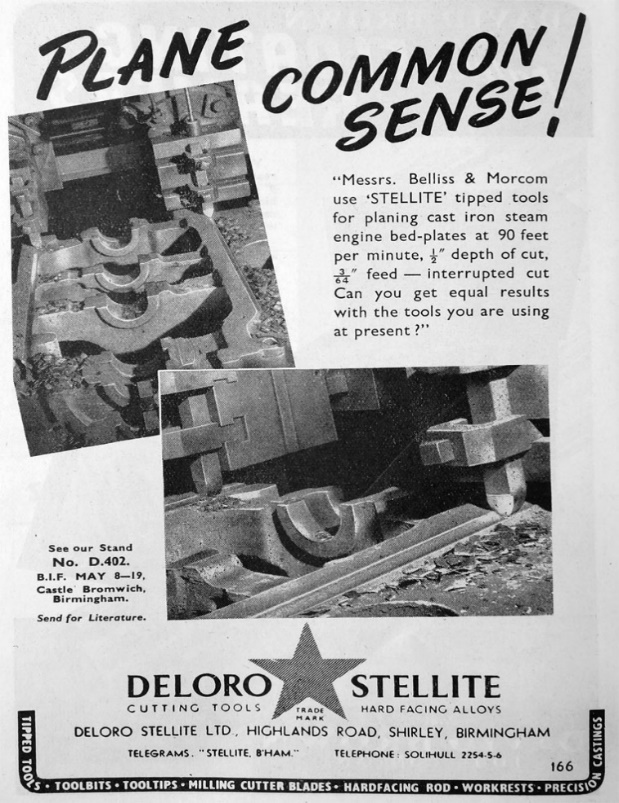
May 1950 advertisement by Deloro Stellite (UK) Ltd, Birmingham
Non-ferrous alloys used for cutting tools are often called cutting alloys. These are distinct from alloy steels, although some may contain iron and be allied to the super high speed steels. They may have a base of nickel or cobalt and usually contain tungsten.
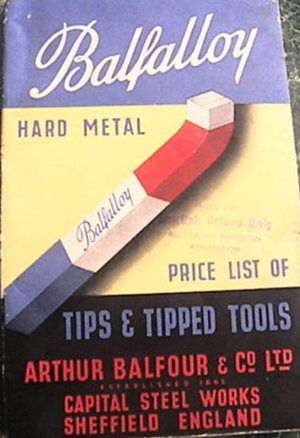
An early alloy of this type knows as ‘Cooperite’ contained 80% nickel, 14% tungsten, 6% zirconium (Zr) or less tungsten and some silicon and molybdenum. An English cutting alloy sold by Samuel Osborn & Co Ltd under the name SOBV (or S.O.B.V) cutting alloy contained high percentages of chromium, cobalt, tungsten, and iron with some vanadium and molybdenum and is more accurately described as a super HSS.
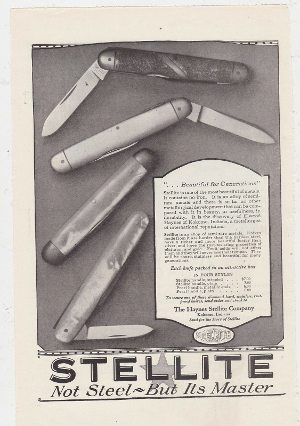
Stellite: Stellite is a non-ferrous alloy discovered by the American metallurgist Elwood Haynes in 1907 and is similar to the modern cemented carbides. In 1912, he formed Haynes Stellite Company to produce one of the new alloys, and received lucrative contracts during World War I, making Haynes a millionaire by 1916. He merged the Haynes Stellite Company with Union Carbide in 1920.
Stellite is made in various grades for cutting tools, hard facing valves, rock bits and crusher rolls. It is typical of the non-ferrous hard metals and the cutting properties are inherent in the alloy and are NOT produced by heat treatment.
Stellite contains from 40-75% cobalt, 15-35% chromium, 10-25% tungsten and about 2% carbon and small amounts of iron and molybdenum. Stellite retains its hardness at red heat.
The use of cast-cobalt cutting tools should be considered when:
- Relatively low surface speeds cause build-up with cemented carbides;
- Machines lack the power or rigidity to use cemented carbides effectively;
- Higher production is required than is possible with high speed tools; and
- Machining rough surfaces of castings where the surfaces contain abrasive material such as sand, oxide, slag or refractory particles.
These cutting alloys were designed to bridge the gap between High Speed Steel and cemented carbides.
The name Stellite is derived from the word “Stella” meaning a star and is an ideal name for when polished Stellite gives an untarnishable lustre.
Stellite may be considered as the forerunner of the non-ferrous cutting alloys. It differs from those alloys which were introduced later in that it is a cast material whereas the others are cemented and sintered products. In its improved form, known as Grade 40 Stellite, it is claimed to be equal to the cemented carbides as a cutting alloy. It is an alloy comprising cobalt, chromium and tungsten, which cannot be heat treated and so is cast in the required shapes and ground to final dimensions. The approximate composition of the Stellite alloys is Cobalt 35-47%; Chromium 25-32%; Tungsten 14-21%; Carbon 0-4% C; and Iron 0-5%.
The metal is softer than HSS but possesses a higher red hardness value and because of its hardened state when cast it can only be machined by grinding. Another valuable feature is that it can be welded making it highly suitable for hard facings such as those on work rests of centreless grinders.
Stellite alloys possess properties somewhere between high speed steel (HSS) and carbide. They can be ground with a standard grinding wheel, though the process can be a bit slow going. They're tough and work well on interrupted cuts and on castings that would tend to chip carbide, though they're more prone to chipping than HSS.
High lubricity is another feature and that prevents welding of material on the tool tip. They cannot be annealed and thus retain their hardness and cutting ability to red heat. In general, they will operate at two-times or more the speed of HSS, but not that of carbide.
Modern cast alloy tools are ground on all sides and have a similar appearance to HSS tooling. They resist corrosion extremely well and may stand out if used tooling for that reason.
Don't be put off by the appearance of older cast alloy tooling; some may look like it was cast in a backyard barbecue. It will be dark in colour and have significant imperfections and poor grinding.
New cast alloy blanks may still be available from three manufacturers, but don't expect to get them cheap!
Stellite is used in the form of solid cast tool bits, tips, parting blades, milling blades and tipped tools. The alloy is at its best when it has plenty of work to do and it is tough enough to take interrupted cuts without chipping. It cannot be rolled or forged and is shaped by casting and subsequent grinding. The tool bits are available in inch and metric sizes.
Stellite retains its hardness at temperatures of 700°C (1290°F) upwards to a much higher degree than HSS or other tool alloys.
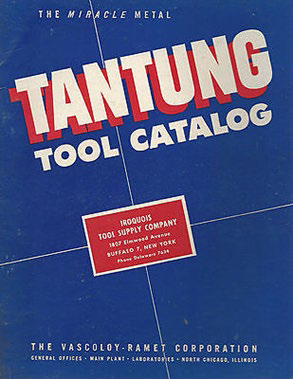
Tantung: The Tantung cast alloy cutting tool material is composed principally of chromium, tungsten, columbium, and carbon in a cobalt matrix. These elements combined in the proper proportions and cast in chill moulds give Tantung its most important characteristic; the ability to retain its cutting hardness at temperatures of up to 815°C (1500°F).
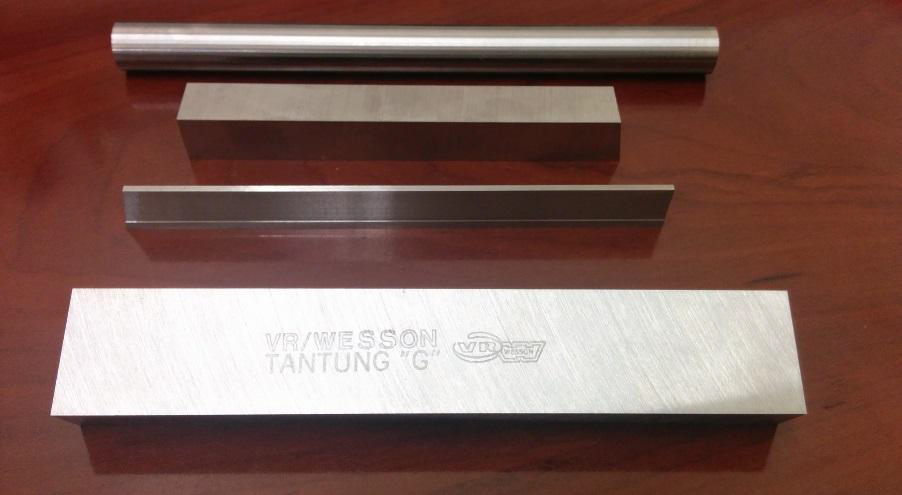
Tantung is neither high speed steel nor carbide.
Tantung has a high transverse rupture strength, low coefficient of friction and excellent resistance to corrosion. It is tough, readily absorbs shock and impact, and is non-magnetic; it likes to work.
As a cutting tool, it is ideal for all turning, facing, boring, milling, and cut-off applications on nearly every type of metal as well as non-metals. Tantung can be run at surface speeds of up to 2.3 m/s (450 fpm) but performs best at speeds of 0.5 to 1.5 m/s (100-250 fpm) and can be used to excellent advantage on machines where speed, power, and rigidity are limited. In addition, it will not anneal or lose its cutting edge as will HSS when subjected to high-red heats generated during the cutting cycle.
Tantung G is recommended for general purpose machining of both ferrous and non-ferrous metal and general woodworking operations. For VR/Wesson catalogue items, Tantung G Hardness is quoted as 60 to 63 HRC and transverse rupture strength is 2070 MPa (300,000 psi) minimum.
Typical composition of Tantung G is cited as Cobalt 35-40%; Chromium 27-32%; Tungsten 14-19%; Nickel 7%; Carbon 2-4%; and Iron 2-5%.
Uranium in High Speed Steel
During the early 1900s a series of exhaustive tests and experiments were conducted with a view of improving the texture and durability of high speed steel. Scientific opinion at the time was that uranium carbide made an excellent alloy with steel and, if it could be obtained at a commercially viable price then, it could potentially replace nickel and tungsten in the manufacture of high-class steels. There were also tests conducted using metallic uranium and ferro-uranium.
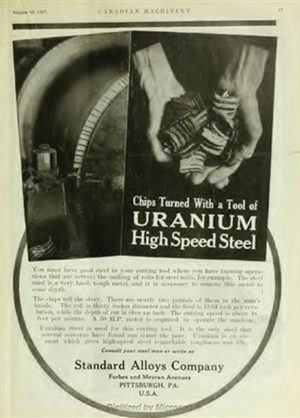
The results from these tests led to the Standard Alloys Company of Pittsburgh PA offering Uranium high speed steel to the consumer with the assurance that it would increase the efficiency and output of the shop through longer life of the tools, due to their toughness and heat-resisting qualities.
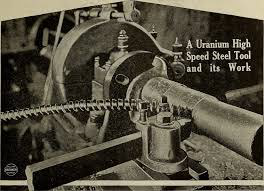
Uranium high speed steel allowed the machinist to take deeper cuts with increased feed at higher speeds compared to any other steel, and the established use of Uranium in some of the best high speed steels for several years demonstrated that Uranium produced desirable qualities that could not otherwise be obtained. Only small percentages of Uranium, in the order of 0.15% to 0.3%, were required to accomplish these effects.
For full details of the Standard Alloys Company’s tests see Uranium in Steel: The history and function of this element in the making of Uranium steels, with analytical methods and test charts. Standard Alloys Company, Pittsburgh, 1921.
The results produced by Uranium in HSS are explainable in the formation of more stable carbides and tungstides. When Uranium is present there is also evidence that complex carbides are formed, which are more readily soluble in the gamma iron. As these carbides have an influence on the cutting qualities, this accounts for the excellence of the cutting performance of Uranium high speed steels.
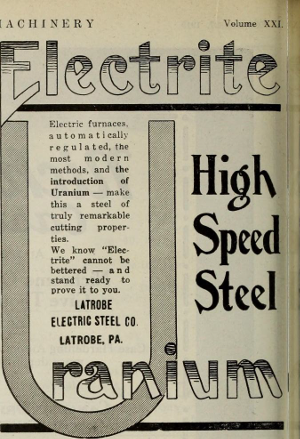
The Standard Alloys Company claimed that “Uranium steel marks the greatest single advance in alloy steels in recent years”. The alloys did not prove to be commercially successful in the long run. However, during World War I and afterwards, uranium-doped steels were used for tools; large amounts of ferrouranium were produced between 1914 and 1916. Production apparently ceased during the 1930s owing to the high costs and lack of demand.
For the next part of the series: Tool Steels: A Brief History — Part 5 Some Important Carbon Tool Steels - Water, Oil and Air Hardening Steels
For the start of the series: Tool Steels: A Brief History — Part 1 Introduction